Monday, October 31, 2016

Apple, give me back my emoji

What have you done, Apple?


You took an entire visual lexicon used by millions of people every day, and changed it. You destroyed iconic images and needlessly tweaked perfectly good ones. Why? Why would you do this? I want my peach butt. I want my cartoon moon. I want my candy heart. I want my emoji back. But you’ll never give them to me.


I actually have to admit I was never a fan of the Apple emoji in the first place. To me they screamed tacky clip art, all color gradients and faux depth. I liked Google’s gumdrop faces, Microsoft’s bold lines, Samsung’s strong characterization.


emojisBut the fact is, most people used Apple’s because they were early to the game and the iPhone was the most popular single brand. Most of my friends have iPhones, but I use Android, so I switched emoji sets rather than guess at what others might be seeing. The threat of misinterpreting emoji is real!


So although I never liked the style, I made use of it, as you do. Like writing in a restrictive meter or shooting in monochrome, the limitation makes the process of expression interesting in itself. They grew on me, as I know they grew on countless others, and we developed shared visual vocabularies.


And because we have used them so often in recent years, we have come to know them much as we know ordinary words. They developed their own connotations, nuances, innuendos — some seemingly accidental, others slyly intentional.

Emoji are interesting to me because they are a mobile-native language — deliberately visual, distinct and glanceable — that both embraces and subverts the intentions of its designers. The language of emoji, as insipid as it sometimes seems, is actually a mountain of context and very human metadata that makes it, like so much visual communication, richly expressive.


The foundation for all that is the images themselves. Redesigning the basis for this incredible and popular form of communication is an act of destructive cultural revisionism.


Okay, yeah, that’s putting it a little strongly, since it’s just a bunch of icons people use to chat with online, but it really does erase a huge amount of context and history, and the gains are slim to none. The changes Apple made to the emoji — I’m not talking about Unicode’s welcome and long overdue gender and skin color modifiers, by the way — are pointless at best and often damaging.


Dang. The ancient Apple emoji — which were never really meant to be seen bigger than 32 × 32 — are redrawn quite well in iOS 10.2! Good job! pic.twitter.com/X6WskExq1D


— Cabel Sasser (@cabel) October 31, 2016


What was the rationale behind, for example, changing the shading on the fruit? What about adjusting the portions in the curry? Changing the perspective on the wine glass? Why have some items gained gloss, while others lost it? Why invert the burrito? Why censor the peach? Why darken the fish cake?


There’s no reason for any of these things. It’s as if Apple told its designers, “go through every emoji and change it a bit, doesn’t matter how.”


Design without purpose isn’t really design. If the replacement isn’t better than the original, why are they replacing it? And if they don’t understand what made the originals valuable — the familiarity and shared symbolism of those exact images — doesn’t that make them poor caretakers of this cultural capital?


Apple won’t roll back these changes, of course. I know this is basically “blogger yells at cloud.” But it’s disappointing to me because I’ve genuinely enjoyed the emerging phenomenon of emoji use, and this move is, like so many by Apple lately, a tone-deaf and user-unfriendly one.


It would be nice to have an open messaging framework where we could choose how our emoji look on other devices, but I’m not holding my breath. But perhaps these new emoji will provide a blank slate on which to build another visual lexicon. I guess they’ll have to — it’s not like we have a choice.

How combined human and computer intelligence will redefine jobs


The man versus machine dichotomy has been a staple of pop culture for decades. From 2001: A Space Odyssey to Blade Runner to Terminator to The Matrix and beyond, film makers have envisioned what the world would look like if artificial intelligence took over.


However, a new mindset is taking shape — the era of AI-human hybrid intelligence. This combination of a human brain and a computerintelligence is known as a centaur. The centaur model sparked the growth of freestyle chess, a context in which Garry Kasparov concluded that “weak human + machine + better process was superior to a strong computer alone and, more remarkable, superior to a strong human + machine + inferior process.”


Kasparov’s statement regarding the centaur model is no longer relegated to the world of chess. As AI innovation continues to grow, we should carefully review the centaur model in terms of the workplace and consider how combinedhuman and computerintelligencewillredefinejobs.


History says machines won’t destroy the workplace


In 1800, farming accounted for nearly 75 percent of the U.S. labor force. However, the Industrial Revolution introduced a number of inventions that led many to believe there would be massive unemployment rates throughout the country.


The applications for the centaur model in the workplace are potentially endless.

The Industrial Revolution resulted in a 25 percent decrease in farming labor by 1890 — but we didn’t see the unemployment that the general public feared.


Instead, jobs moved to factories and eventually white-collar jobs like stockbrokers and business consultants emerged to further stabilize the workforce. Now, as we enter the Intelligence Revolution, it’s important to realize that technology won’t create historic unemployment rates.


Like in the 1800s, technology will result in the decline in certain types of jobs, but new positions that we haven’t even envisioned will give people an opportunity to fill in the gaps that machines can’t — seeing the big picture, thinking creatively and connecting seemingly disconnected ideas.


Thinking of technology as a means of reshaping the workplace rather than a means of replacing any and every job, you can see where the centaur model can redefine employment.


Where the centaur model fits into the workplace of tomorrow


Being a centaur in tomorrow’s workplace means combining your own emotional intelligence with the analytical power of AI-enabled technology. Google’s Deep Dream Generator is a good example of how this will work.


The Deep Dream Generator turns vision algorithms inward to display what neural networks see when analyzing an image. Now, Deep Dream is being used to create intricate artwork — but it can’t create images from nothing. The Deep Dream Generator relies on human input, a seed from which it can create art.


Being a centaur in the workplace means taking advantage of the vast analytical capabilities of AI-enabled technology and adding human thinking. The applications for the centaur model in the workplace are potentially endless, but here are a few example fields that are well-suited for the combination of deep analysis and human creativity:

  • Security and network planning: The volume of cyber attacks will continue to grow and AI will become increasingly necessary in threat analysis. However, attackers will always be creative, launching non-computerized vectors to compromise business networks. This is why humans will be necessary to prompt machines toward new ways of keeping creative attackers at bay.
  • Visual arts and music: Collaboration will replace the linear nature of artistic creation that we think of today. Two different algorithmic versions of a music program could give a human enough content to combine the two and generate an entirely new genre. Or, like Google’s Deep Dream, humans can input seeds of information for machines to generate artistic products.


  • Film and television: There are enough test cases for us to truly understand what a well-framed scene looks like. Teaching a machine how to essentially direct means filmmakers can set up scenes in VR and focus more on storytelling and creative connections than the minute details of production.

  • Architecture and product design: Function over form has dominated each of these fields. However, leaving a machine to design based on function over form might have us living in buildings that are just white boxes. However, IoT sensors can teach machines how we interact with our environments to learn exactly what people need in terms of function, leaving humans to balance function with form — spending more time on the art and less on the details.
  • Software engineering: Development is often thought to be a non-creative discipline, but the best software code is also the most creative. The best developers of tomorrow will direct computers on a certain problem, examine the output and continue to redirect machines until they have new ways to solve old problems.

It’s easy for a conversation about AI to devolve into a philosophical discussion about consciousness, because that’s what we bring to the table — a sense of consciousness and intuition that machines don’t possess.


But there’s no way around it; AI is going to redefine the workplace. However, machines are terrible risk takers and have no capacity to make leaps of faith. Rather than thinking about whether or not machines will rule the world, let’s think about how we can become workplace centaurs that creatively redefine the jobs of tomorrow.

Featured Image: YuLi4ka/iStock/Getty Images

Photo app Ever removed its spammy SMS feature after Apple banned it

Score one for the consumer against the indefatigable force of growth hacking. Ever, the photo storage app that we called out in September for spamming SMS contact lists (it rebranded from Everalbum shortly after), has found its way back into Apple’s App Store after getting temporarily banned for its practices.


Ever has had a lot of negative feedback — and even a couple of lawsuits — over how it leads you into sharing your contacts with it, and then subsequently messaging them with its marketing. Despite that — or rather, largely due to that — the app has been on a popularity tear. In the last month, it has consistently ranked No. 1 or within the top 10 among all Productivity apps in both the Android and iOS U.S. app stores, according to App Annie figures.


  1. screen-shot-2016-11-01-at-3-16-32-pm


  2. screen-shot-2016-11-01-at-3-17-24-pm


In Apple’s iTunes App store, however, there’s been a blip: it disappeared, along with its billing function, used by paying “Plus” users ($9.99/month) or those who want to purchase physical photo books (which start at $19.99). From what we understand, this was squarely down to how it misled users into providing access to their contacts list and then spamming them to use the app.


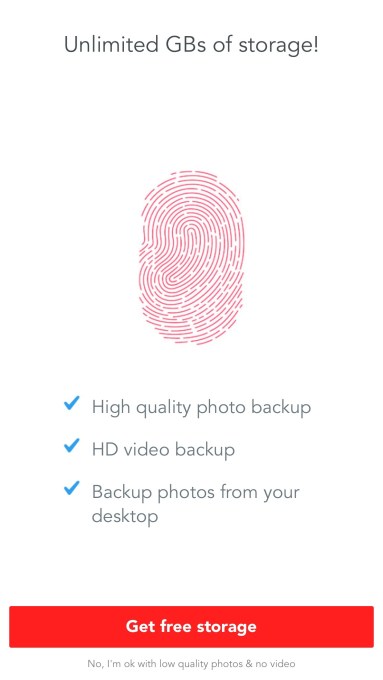
According to a number of consumer complaints, Ever (then Everalbum) had duped them into spamming their friends with invites to try the service. The app’s user interface used a variety of techniques to get users to agree to this invite spam. This included a tricky button that heavily emphasized the option to “get free storage,” which then prompted you to let the app access your contacts). The following screen would show all your contacts checked by default, while the option to “Deselect All” was grayed out to make it less obvious.


img_0035


But it’s unclear whether users were just confused about what they were agreeing to, or if Ever had actually used different, and less transparent, onboarding flows at other times.


The end result, however, was that many of Ever’s users felt they had been tricked into sending out SMS spam.


img_0034


In addition, Ever also sent out a number of different and misleading SMS text messages that implied your friend had given you access to view photos in their album, or threatened a link would expire if you didn’t click it soon. But users hadn’t necessarily shared albums — they were just navigating their way through the set-up process.


Apple removed the app from its iTunes App Store for its bad behavior — specifically SMS spam and for being misleading. It was only allowed back in when the “invite via text” feature was removed. Google, however, never took any action, despite its recent claims of clamping down on apps that try to manipulate their rankings.


In the new version of Ever, now back on the App Store, the app no longer prompts you to sign up your friends, and it has a much clearer interface for its in-app upgrades:


  1. img_0997


  2. img_0998


  3. img_0996_2


  4. img_0999


Now, the options for starting a free trial are clearly labeled, and the trial only begins after you enter your TouchID and confirm your commitment to the subscription terms ($11.99/mo after the trial period.)


When testing, however, we found a new problem: after choosing to upgrade, but then cancelling before you continued to the trial, the TouchID prompt kept popping up. We had to hit “Cancel” on its repeated prompts to get it to go away for good. This could be a bug with the new app, or a new means of confusing the user — it’s unclear. (The new app does appear buggy, though — the album sharing button wasn’t working during tests, for instance.)


screen-shot-2016-11-01-at-3-15-27-pm


However, when sharing photos (or presumably, an album), you have to explicitly type in a contact’s name or select from your “recents.” The app doesn’t indicate it’s sending a text on your behalf, but at least only the recipient — and not your entire address book — is being bothered. The text will point your friend both to a mobile web version of the app and to the App Store to download Ever via two included links.


While Ever may have cleaned up its act, it’s clear that its growth hacking techniques gave it an advantage, given its continued high ranking. That, sadly, could still encourage other nefarious app developers to use similar techniques in the future.


Unfortunately, the courts have not been on consumers’ side, either. Previous lawsuits related to SMS marketing citing the TCPA (Telephone Consumer Protection Act), which specifies consent requirements for marketing, have been dismissed. These include cases brought against WhisperText (Whisper), Shopkick, Life360, Lyft and others, over the years. The suits against Ever are still pending.

Genetics startup Genos wants to pay you for your DNA data

The first whole human genome sequencing cost a whopping $2.7 billion. That didn’t bode well for making any breakthroughs on genetic disorders. Luckily, the cost has dropped dramatically since then, leading to a new breed of consumer genetics startups taking a deeper dive into all the double helix’s that make up you.


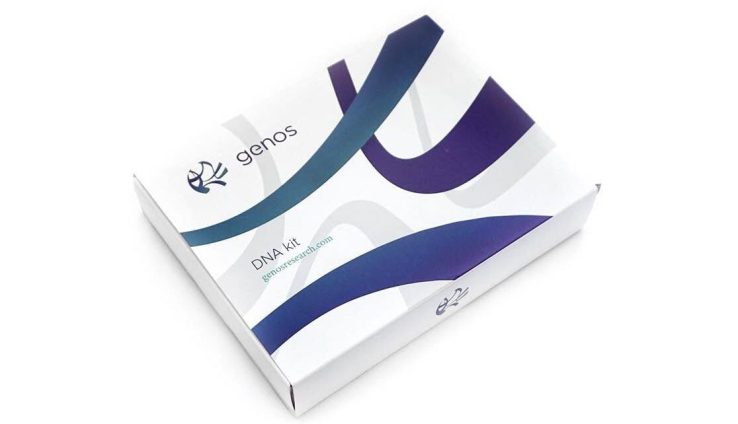
Genos is one of those startups using a next-generation sequencing process to both give you a good idea of your heredity on a deeper level and give researchers a crowdsourced genetic map to help with disease discovery.


The startup says it will sequence your whole genome in the near future, but is starting by sequencing your exome — or all the genes that translate their information into proteins in a genome. The exome is especially important in discovering diseases caused by rare genetic variants.


unnamed


So instead of giving you information in SNPs (or “snips”), you get a voluminous amount, adding richer detail to your genetic makeup.


23andMe recently halted this type of next-gen sequencing and founder Anne Wojcicki called it “the hot, shiny object” of the industry at the WSJD Live conference last week. “But what you’re going to do with all that information is extremely complicated,” she said, adding that her company doesn’t want there to be any ambiguity in the results.


Next-gen sequencing could tell you there’s a very slim chance you’ll get a certain form of breast cancer, for instance. But, as Wojcicki pointed out, it’s not clear what you might need to do about that information — if anything.


However, there are plenty of others working on ways to offer up deeper data, should you want it. Like Genos, Color Genomics, Helix and Veritas are all betting on the newer and more liberal sequencing techniques to fish out information and give us a better understanding of our chances for disease.


Each of these newer genetics startups has a different approach to gathering and implementing the data. Genos is creating a map by encouraging individuals to aid the research process. 23andMe and other genetics startups do this to some extent by asking participants to voluntarily take a quiz or opt-in to a certain study. But, instead of asking people to sign a blanket consent form, Genos plans to incentivize people by paying for their information each time.


Will the economics work? That part is unclear. How much Genos will pay is up for debate at the moment, though the company says it will be revealing how much participants could expect to make closer to its official launch a few months from now — it’s also worth noting that plenty of genetics companies are currently getting voluntary information for free.


In the meantime, Genos is gearing up for that aforementioned launch and just closed on a $6 million strategic investment from cancer discovery platform NantOmics. Its advisory board also includes George Church, a leader in genomics research who helped initiate the Human Genome Project; Nobel prize winner in economics Alvin E. Roth; and former Uber exec Mina Radhakrishnan, who is now an EIR at Redpoint Ventures.

Other genomics startups have raised more and are further along in deploying their products, but Genos’ approach to gathering data by paying for it seems an interesting one, and the company has a good team behind it. We’ll just have to see how it goes.

Featured Image: MIKI Yoshihito/Flickr UNDER A CC BY 2.0 LICENSE

Jack Dorsey gets another break with a strong third quarter from Square

While Jack Dorsey’s other company Twitter might be struggling, Square continues on a roll that’s keeping Wall Street happy.


There’s going to, as always, be a big question mark for Square because of Dorsey’s tenure at Twitter — which is hardly going well. While the company’s latest quarter showed a flash of optimism, the company’s efforts to close a sale with Salesforce and other potential bidders fell through for a number of reasons (trolls included). There are questions of Dorsey’s ability to navigate Twitter’s complex problems, and that could easily extend to Square.


Still, things at Square seem to be going well. The company reported another solid performance in the third quarter, beating Wall Street’s expectations. It reported revenue of $439 million and a loss of 9 cents per share, compared to estimates of a loss of 11 cents per share on revenue of $431 million. Shares were up as much as 6% when the report came out, and are up around 4% right now.


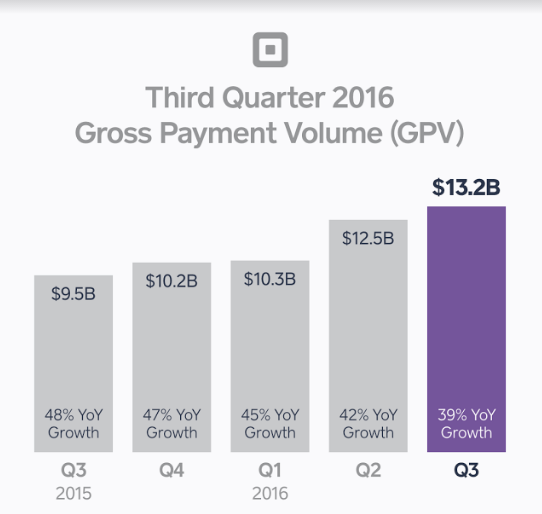
A lot of the other key metrics for Square continue to rise. Gross payment volume — a measure of how much money is flowing through the company — was up 39% year-over-year in the third quarter to $13.2 billion. The company also said it processed more than 35,000 business loans for a total of $208 million, which was up around 70% from the third quarter last year. Square also said it had margins of around 7%.


square gross payment


The company’s hardware revenue also hit $8 million this quarter, and Square said “sales of our contactless and chip reader remain strong.” As a lot of standards shift to chip-based EMV cards — and potentially Apple Pay — Square is going to need to keep that hardware rolling out to keep up with other point-of-sales systems. (Though, the transition to chip-based card readers in the U.S. isn’t going spectacularly well at the moment.)


Last quarter, Square got a much-needed bump when it reported better-than-expected results. In particular, the amount of funding Square Capital extended more than doubled year-over-year in the second quarter. That’s going to be increasingly important for Square, as it would seem that with the oomph the company is throwing behind it Square Capital could evolve into a tentpole service for the company.


That’s not without challenges, however, as in recent months — especially following the Lending Club CEO exiting fiasco — institutional investors have become more wary of alternative investments. If it becomes more difficult to gather capital to extend as loans, that means Square will have to dip into its own pool and take a big risk on its potential clients. That kind of capital is important to continue growing quickly, and Square needs to build additional services beyond the company’s point-of-sale system.


Case in point, Square reportedly looked to hand off Caviar for around $100 million to a competitor like Uber or GrubHub, though it didn’t end up finding a buyer that would pay enough. Square is still looking for additional revenue streams, and it needs to do that if it’s going to prove to be a strong independent company and not just fill a slot for a larger financial organization.

In the past year, Square is down around 15%. It has had a rocky path for the past twelve months, and while its last quarter showed some positive signs, it’s going to have to keep doing that to convince Wall Street to leave it — and potentially Dorsey — alone.


With the upswing, Square once again pushed up its guidance for the fourth quarter and the full year. The company expects $438 million to $443 million in revenue for the fourth quarter, which fell around where Wall Street was expecting.

Featured Image: TechCrunch / Matthew Lynley

For Roli, the future is modular

Roli wouldn’t say much before our demo. Just that the company was showing off something new, and that we would probably want to bring a camera. So when we arrived, expecting the latest take on the company’s flexible Seaboard instrument, we weren’t quite sure what the make of the thing.


It’s a small, wireless square that has little in common with the London-based startup’s prior output. Its face is made up by a 5 x 5 grid of light up squares that respond to touch. A few minutes into the presentation, I found myself asking how, precisely the device was different than a Kaoss Pad, Korg’s popular effects processing MIDI interface.


“It’s a instrument in and of itself,” explained the rep demoing the device. And indeed, like the Seaboard, the Blocks system is as much about music creation as it is control. It’s an attempt by the company to offer up a device that lowers the barrier of entry significantly from its other offerings, both in terms of price and ease of use. Roli is calling the system its “first truly mass market consumer device.”


Here’s a quote from Grimes about the system. “Roli Blocks will democratize music production. It’s so intuitive and versatile. I’m always on the go, and Blocks is the most powerful mobile production tool I’ve ever used.”


img_1729


So, she’s a fan. The RZA was also kind enough to give us a quote about the system as well, “If I ever have writer’s block in the studio, I reach for Blocks. It brings whole new levels of expression to my music.”


blocks_002_360-1-gif-png


The price point is certainly right. The base Lightpad runs $179. Players create music through a series of swipes and pushes on a semi-malleable surface made from the same material as the Seaboard’s bendable surface. The parameters of the 25-square surface is determined on the company’s Noise app, including genres, instruments and scales – making it impossible for the player to hit a “wrong note.”


img_1710


The company will also be making artist sound packs available from the above musicians and more, including electronic musician Steve Aoki. Here’s a quote from him, “I’ve been a fan of Roli for years and so I was honored to create signature Aoki sounds for the new highly expressive Block system.”


Roli will also, naturally, be building a social network of sorts around the app, so users can share their creations. And the Noise app will be usable even without the hardware. Additional Live and Loop blocks will be available as well for $79, snapping onto the base Lightpad to create a full system.


img_1792


I played around with Blocks a bit during the demo and can confirm that it’s a fun little system with an intuitive interface that require a lot less in the way of knowledge than Korg’s offering. I could easily see losing a few rainy afternoons to music creation on the thing – and it will certainly be interesting to see what actual professional musicians (of which I am certainly not one) are able to do when they get their hands on it.


blocks_001


The rest of us will be able to try to system out today at a select number of Apple stores.

Gigster’s crafty plan to give freelance developers equity


“401k? Stock options? Freelancers get none of this. We want to make it more like working for a startup to freelance for Gigster,” says founder and CEO Roger Dickey. His startup Gigster turns clients’ ideas into full-fledged apps by coordinating freelance product managers, engineers and designers. Today it’s launching an innovative way to retain its best contractors and align incentives so they work harder for their clients.


Gigster is launching the Gigster Fund, comprised of $700,000 raised from Bloomberg, Felicis and China’s CSC as LPs, plus 1 percent of Gigster’s own equity. Each month it will invest $50,000 cash in one of Gigster’s top clients in exchange for 1 percent of that company at a $5 million valuation. Gigster will also provide them with advice, connections, fundraising help, priority access to its top talent and the option to hire their freelancer squad to come in-house.


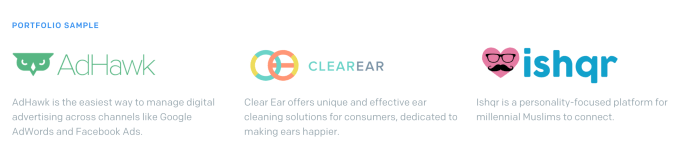
gigster-fundDickey touts that Gigster Fund’s arrangement charges startups 3X less equity per dollar than Y Combinator and 2.5X less than 500 Startups, though without a bootcamp program. Some of the portfolio companies so far include a Stanford-backed medical device company, a Techstars-funded startup called AdHawk staffed by ex-Googlers, a developer tool created by the founder of a public company and a dating app called Ishqr for Muslims.
But what’s special is that Gigster isn’t keeping all the potential carry from the fund. The first $700,000 in returns pays back the investors. But after that, investors and Gigster split the surplus carry, with Gigster giving its share to its freelancers.


Each month, a share of Gigster’s future proceeds from the Gigster Fund is distributed equally among all Gigster freelancers active that month. So if the fund runs for a year, eventually it earns Gigster a carry of $12 million (beyond what the investors get), and therefore allocates $1 million in proceeds each month; then, if 100 freelancers were active, they’d each receive $10,000 for that month.


screen-shot-2016-11-01-at-12-06-21-pm
Essentially, Gigster’s freelancers could possibly receive what Dickey calls “A little bit of a retirement benefit” if they help their clients succeed and stay active with Gigster for a while. “Every successful company compensates their employees via equity,” Dickey explains. The SEC won’t let Gigster give freelancers equity in itself directly, so “the best way to replicate that is to give them equity in the clients they’re working with.”


This all, of course, depends on Gigster and its clients making it big. Gigster’s on the right path, having launched in July 2015 to let bigger companies and entrepreneurs alike outsource the entire app development process rather than having to manage individual freelancers themselves. It saw $1 million in sales its first two weeks, and Gigster raised a $10 million Series A led by Andreessen Horowitz just four months later. Now it’s seen enterprise sales grow 9X quarter over quarter while signing clients like MasterCard, IBM and PepsiCo.


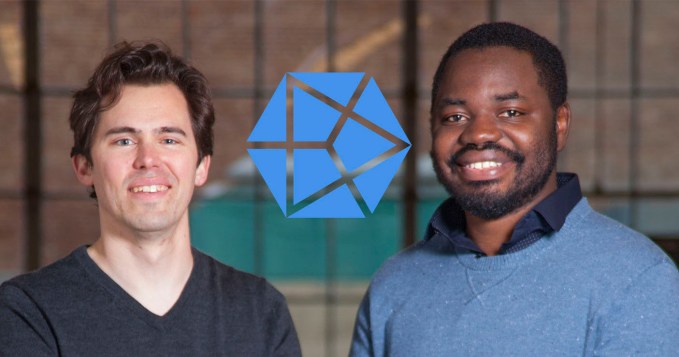
Gigster co-founders (from left): Roger Dickey and Debo Olaosebikan

Gigster co-founders (from left): Roger Dickey and Debo Olaosebikan


That rapid growth can also cause a bit of chaos. I’ve heard stories of Gigster vastly underestimating the cost of projects, and clients getting pissed when they have to up their budgets. Clients also have to go back and forth with their Gigsters to continue maintaining and updating their apps. If those processes prove too bumpy, it could discourage future Gigster customers.


But demand is still through the roof as software eats the world and every company becomes a tech company. Businesses who need apps but don’t know how to develop them are turning to Gigster for its well-vetted talent and low-hassle solutions.


built-with-gigster

Built with Gigster


Beyond the potential benefits for clients, freelancers and Gigster, the fund could also spark conversations about what other companies could do to support their contract workers. “A lot of startups are afraid of doing this because they’re afraid of getting ‘paid for work’ classification issues. It does make startups a lot more weary of doing anything that could approach employee status,” says Dickey.


Many startups in the on-demand gig economy space like Uber are either fighting or actively trying to avoid lawsuits that might force them to treat “1099” independent contractors as full-time employees entitled to expensive benefits. Since Gigster’s freelancers are white-collar knowledge workers, Dickey thinks it can get away with providing this perk. Despite that risk, Dickey says, “We made the call that we wanted to do what we thought was right.”


If the scheme works, Gigster could marry the best of freelancing’s independence and flexibility with the best of full-time employment’s potential upside through equity compensation. That might convince the best PMs, coders and pixel pushers to cast off the shackles of the 9 to 5 and gig with Gigster. Then it could dangle that talent in front of clients who wouldn’t be able to hire so well on their own.


  • 0


    SHARES